Search






A garden‑led family home in North Bondi where brick, concrete, and translucent screens stage everyday life against a dense edge of planting.
At North Bondi’s sandy flat, one block in from the corner shops, a low brick house tucks behind a green parapet and a corrugated street door. It’s Clifton House, designed by Anthony Gill Architects for a builder and his young family. The 415‑square‑meter lot is unusually large for the area but heavily overlooked, so the project starts with landscape: layer the boundaries with planting, set rooms against gardens, and let light and air slip in between.

From the footpath, there’s no fence—just a planted verge and a concrete apron where a ribbed metal door lifts like a shutter. The entry path slides down the side garden and reaches the middle of the plan, where a tall glass pivot opens with a soft swing. This central arrival splits the house cleanly: living spaces to one side with long views to the backyard; quiet rooms and utility fspaces to the other. Inside, the plan steps in four gentle shifts to take up the site’s fall from street to yard. That move gives the lounge extra height without shouting about it—floor lowered, retaining wall expressed, daylight pulled deeper into the interior. Rooms stagger along the site so each can lean onto its own pocket of green. Circulation reads as a calm spine; thresholds tighten, then open to framed views of ferns, grasses, and palms.
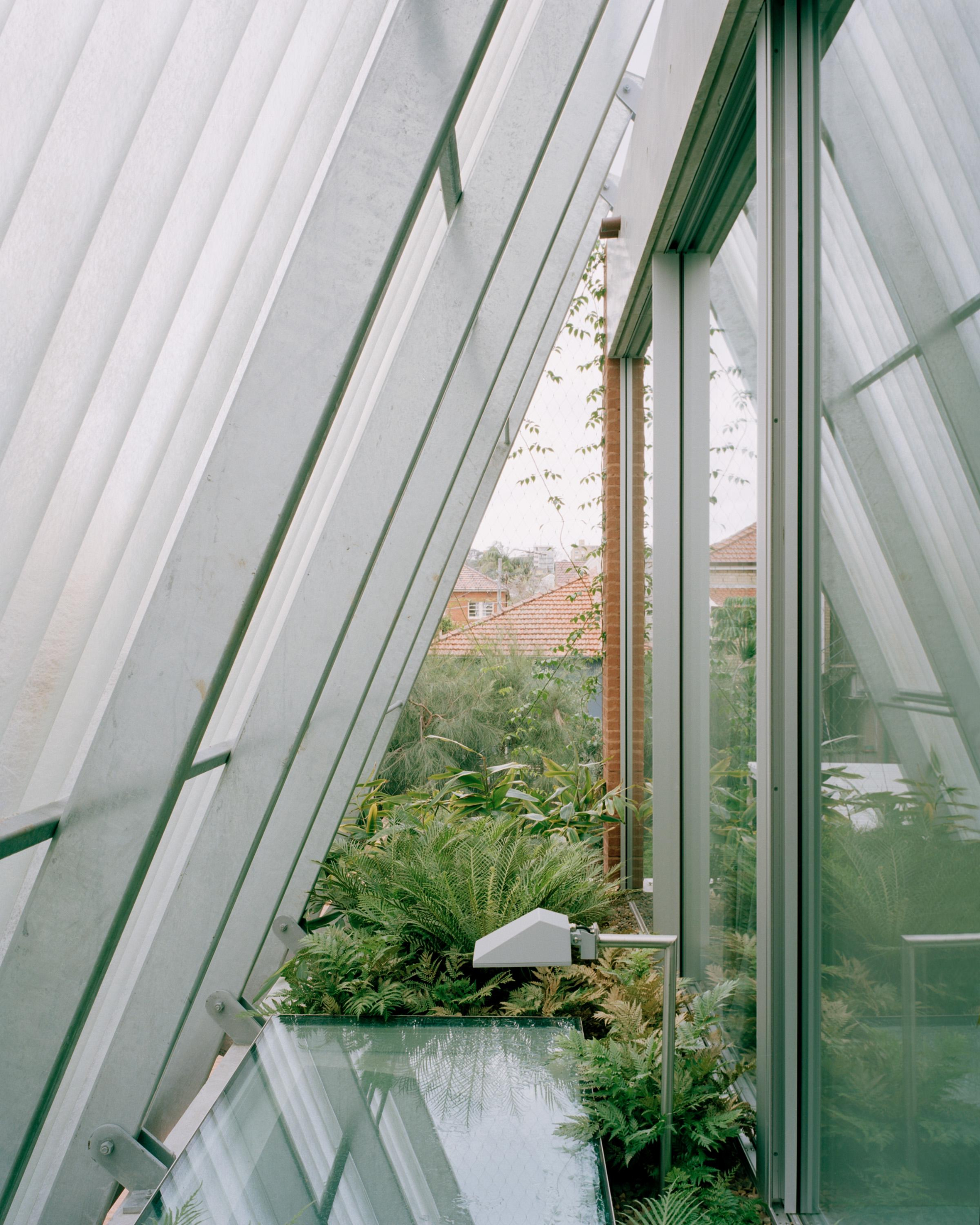
Upstairs, a compact corridor connects four bedrooms and a bathroom. Full‑height openings run the width of each room, sliding to roof gardens that sit like planted ledges. Privacy comes from sloping fiberglass screens—translucent, corrugated, and tuned in angle to local setback rules. They soften glare, filter views, and collect a milky daylight that washes the concrete soffits and the pale walls. Standing there, you catch rooftops through gaps in the screen and the thrum of the neighborhood drops a register.
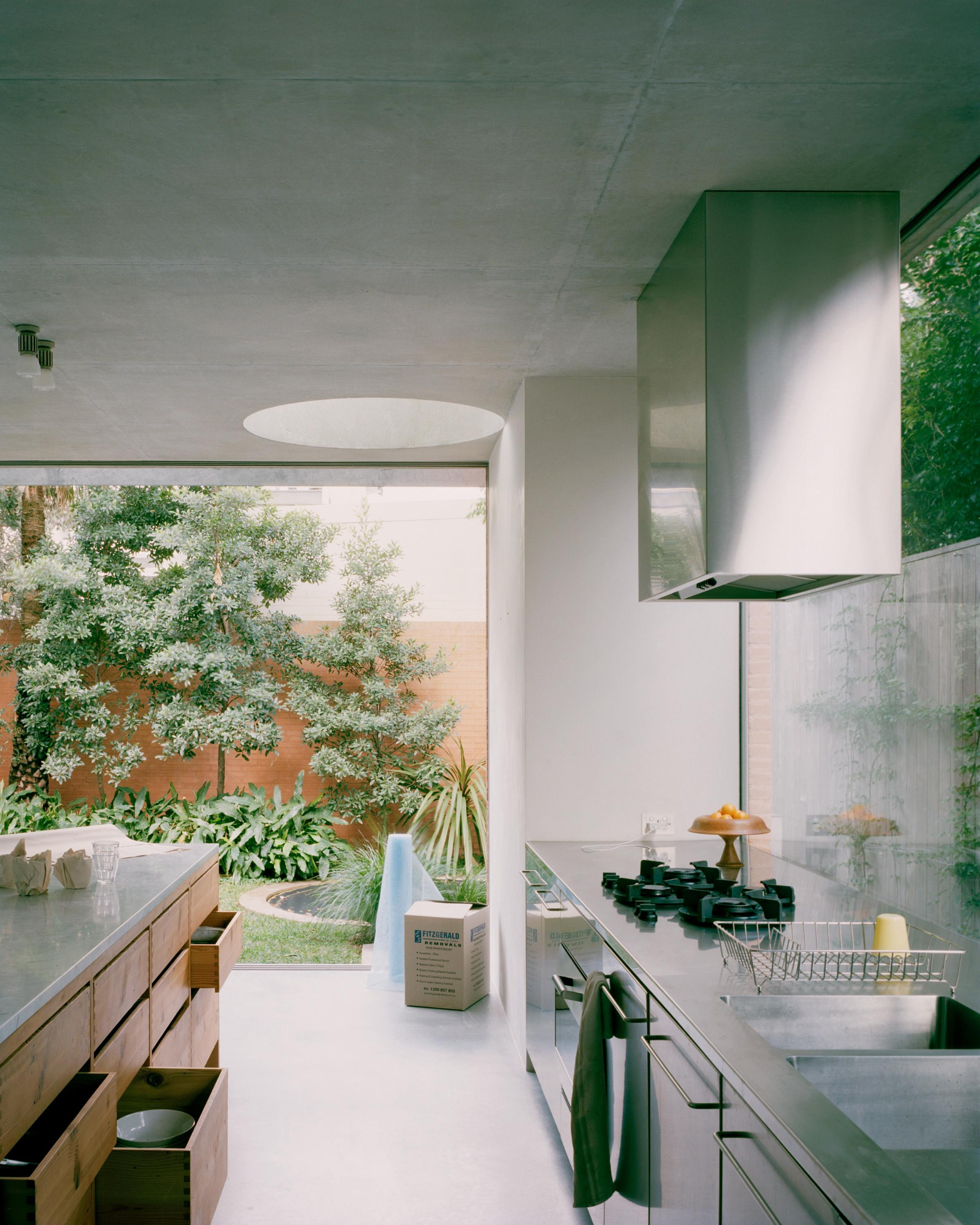
The back lanes of Bondi are a rough collage of buildings, many in red brick. The house answers in kind. New brickwork wraps the exterior, while the inner leaf uses brick recovered from the original single‑storey bungalow. Internally, that brick receives a natural render left unpainted and sealed with wax; the result is a warm, dry surface that records light rather than competing with it. Timber framing from the old roof—Oregon—comes back as the kitchen island and a run of internal doors, again waxed rather than lacquered. Underfoot, concrete floors keep a low, even tone; at the bench, stainless steel runs the length of the kitchen and reflects a round pool of daylight from an oculus cut through the slab above. Details stay straightforward: exposed door edges, simple pulls, the rhythm of plywood grain across storage.

Planting isn’t decor here; it’s the working fabric of the house. Dense gardens pad the perimeter to take the sting out of close neighbors. Smaller beds slip between rooms and walkways, tempering acoustics and cooling air as it moves through. On the upper level, the roof gardens push up against glass, so a chair set by the window shares space with leaves at arm’s reach. The house reads as a sequence of near and far greens: a palm trunk in the side yard, low groundcover at the pivot door, a band of ferns tucked under the pitched fiberglass.
You feel the section most clearly in the living spaces. A couple of steps down and the ceiling lifts; sound settles; the view to the yard widens. Drawers in the Oregon island slide open with a solid run; bowls and pans sit heavy in their timber cells. In the late afternoon, the stainless bench picks up the circular skylight and throws an even glow across the cooktop. Doors slide back and the kitchen joins the garden, the air pulling through from the side path to the lawn.
The decision to reuse materials came early. Bricks from the bungalow form much of the interior shell; salvaged Oregon takes on daily wear at hand height; new brickwork acknowledges the neighborhood’s most common fabric. Shade increases through native planting, lowering heat gain and sharpening the microclimate around the house. A 9.3kW solar array with battery storage, EV charging, and a 7,200‑liter water tank round out the services—quietly folded into a house that’s built to be used hard over time.