Search






A monolithic concrete house works as a hinge between the tram line and a walled garden, using a tall garden room and twin stairways to shape daily life.
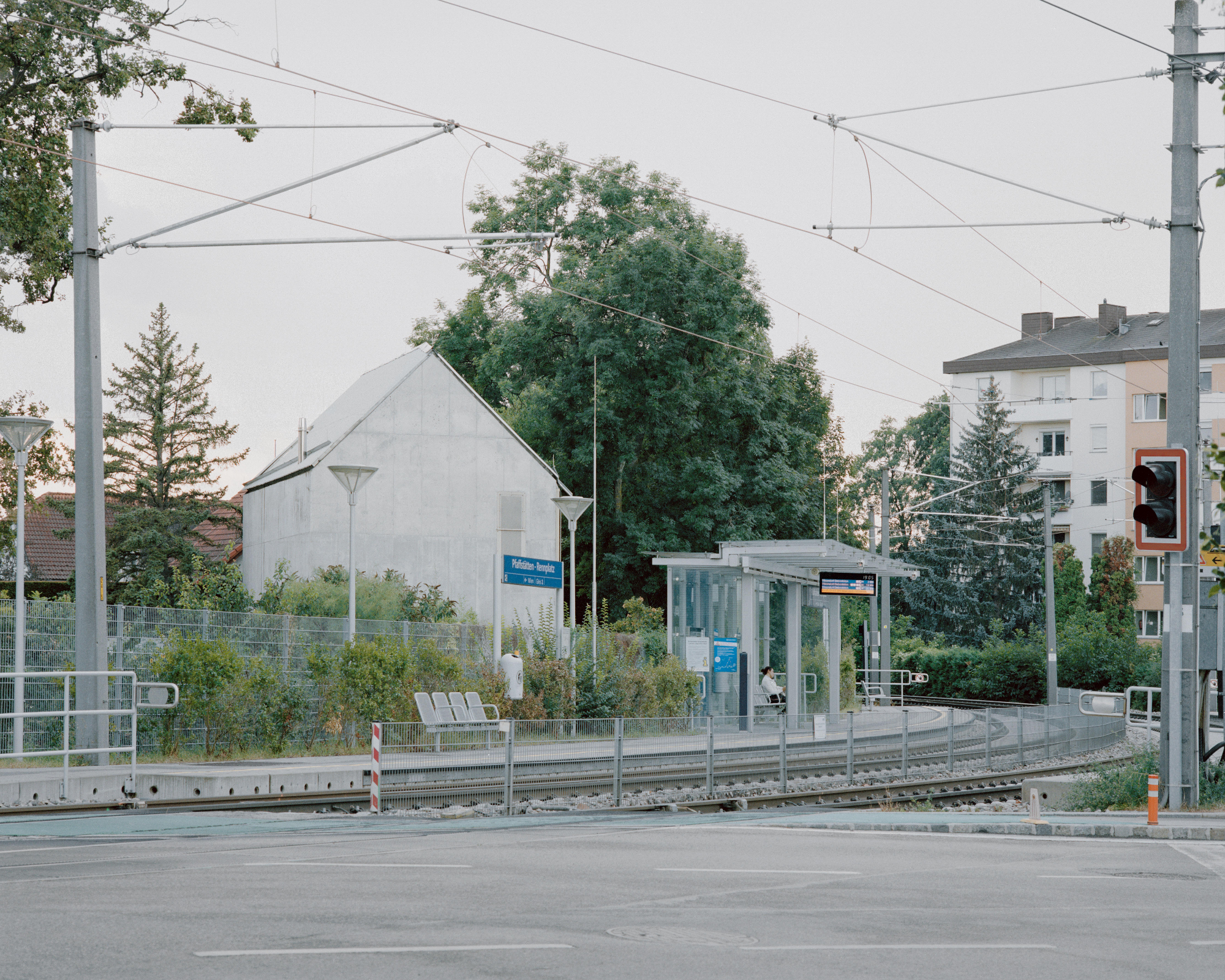
At Pfaffstätten–Rennplatz, a stop on the Badner Bahn light-rail south of Vienna, a gabled concrete house sits on the bend of the line. The house occupies a sliver cut from a former villa’s grounds: tracks on one side, a high wall on the other. A private path along the line ends at the front façade; beyond the threshold, the wall encloses a near-square garden that is only accessible through the house. The building takes on both roles—divider and connector—addressing the platform with a calm face while turning long, low apertures toward the garden.

Construction holds to one system. A 55-centimeter insulating-concrete shell forms the envelope—diffusion-open, with the same surface inside and out. Interior partitions and slabs are 15-centimeter reinforced concrete, and the heating/cooling pipes are cast directly into the floor plates. The result is a thermally activated mass with slow, even temperature. Pour lines, tie holes, and fine-aggregate floors keep the material legible; above, the corrugated roof and a pair of panels read as straightforward utility.

The plan splits lengthwise. Where the garden wall folds into the building, it sets the entrance and releases a tall, narrow room along the garden: more than 10 meters high, nearly 12 meters long, just over 3 meters wide. This empty half opens to the garden with a continuous aperture veiled by a full-length curtain. From here, two staircases rise in separate runs—one at the edge, one in the middle—twisting past each other like a quiet double helix. They serve the full half on the track side, where six rooms across three floors share the same footprint and a fixed north window to the line; ventilation doors face away from the noise. Because the stairs climb at different rates, ceiling heights shift, giving otherwise identical rooms distinct registers. The two sequences never join, so neighboring rooms feel deliberately apart.
Daily use softens the concrete. The long kitchen tucks under the stair with a matte island and steel rack; the dining table sits along the garden aperture, the curtain managing glare and privacy. In the living room, a low amber sofa, deep blue shearling, and resin tables set a warmer scale around a shallow firebox. The bathroom stays in the same register: white tub on short metal legs, circular rail for the curtain, plants on glass shelves that roll toward the light. On quiet evenings a train slides past the north window and the overhead wire draws a graphite arc across the glass; on the other side, the garden curtain lifts slightly, tracing the air along the concrete reveal.