 Search






Long before cabbageware became a decorating trend, a Portuguese caricaturist turned cabbages, tomatoes, fish, frogs, fruit, and shellfish into functional ceramics. The results were part naturalist study, part social joke—and strange enough to remain relevant more than a century later.
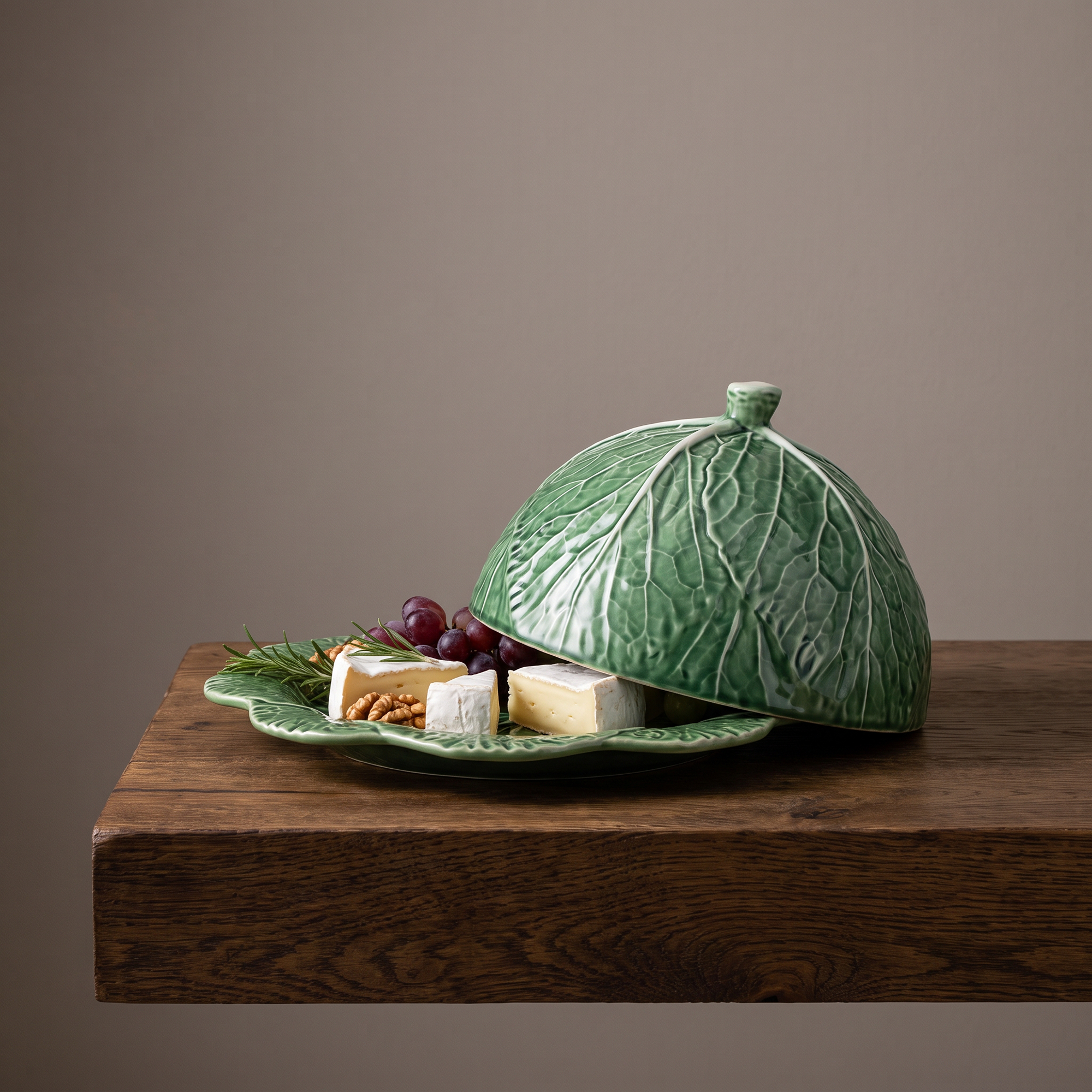
A cabbage is not normally asked to carry the room. It is chopped, boiled, folded into soup, and cleared away before the better china appears. In Bordallo Pinheiro ceramics, however, the vegetable becomes the china. Its leaves flatten into plates, curl into bowls, climb the sides of pitchers, and close around tureens large enough to dominate the table.
The transformation is technically impressive, but that alone does not explain the cabbage’s survival. Plenty of nineteenth-century ceramics demonstrate virtuoso modeling. Far fewer remain funny.
Rafael Bordalo Pinheiro understood that realism and caricature are not opposites. Both begin with close observation. The naturalist studies every vein, wrinkle, scale, stalk, claw, and expression. The caricaturist decides which one should be made impossible to ignore. Bordalo did not abandon caricature when he began working in clay. He gave it weight, glaze, and a place at dinner.
A Cabbage Enters the Dining Room
The history of Bordallo Pinheiro cabbageware is usually compressed into a pleasant account of an artist inspired by nature. The real idea is sharper.
The company’s own description presents the stalky, wrinkled cabbage as a metaphor for the rustic character of Portugal—the same rural country Bordalo repeatedly examined and satirized. By turning it into elaborate tableware, he placed a humble vegetable at the center of bourgeois dining, a room from which it would ordinarily have been excluded.
That move contains affection and mockery in equal measure. The cabbage is honored through enlargement, detailed modeling, and glossy color. It is also made ridiculous. A vegetable associated with ordinary cooking arrives dressed for dinner, demanding as much attention as silver, porcelain, or an expensive flower arrangement.
Its anatomy happens to be exceptionally useful. Broad leaves already resemble shallow dishes. Their central ribs create visual structure. Overlapping layers form bowls and covered vessels almost without requiring the designer to invent a new geometry.
Yet Bordalo’s cabbage is not a botanical specimen translated neutrally into clay. The veins are deepened. The edges become more theatrical. The leaves gather into an idealized version of cabbage-ness, greener and more emphatic than the specimen that left the garden.
The work is recognizable because of naturalism and memorable because of exaggeration.
It also functions. The same leaf that carries a class joke can carry olives, salad, fruit, or soup. A ceramic cabbage bowl does not need to be understood as satire to earn its place in a kitchen. The design can operate at several levels at once: utensil, sculpture, botanical impersonation, and social provocation. That is a considerable workload for a vegetable.
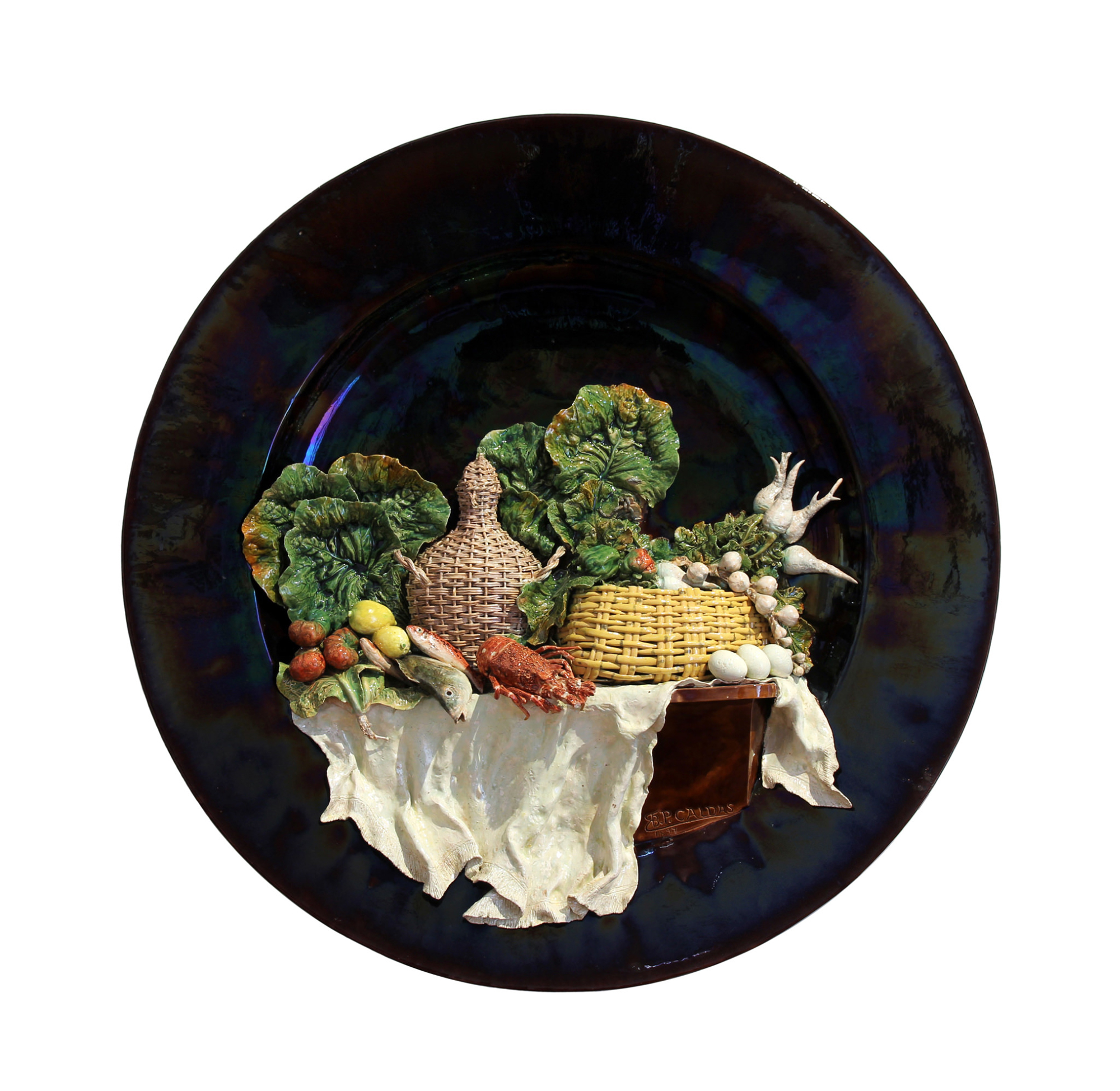
Rafael Bordalo Pinheiro, Prato para suspensão “Mesa Posta,” c. 1897–98. Fish, vegetables, fruit, poultry, baskets, and cloth are modeled as a ceramic still life.
Before Bordalo: The Naturalist Ceramics of Caldas da Rainha
Any serious account of Bordallo Pinheiro ceramics history has to begin before Bordalo. Caldas da Rainha already had a long and unusually irreverent ceramic tradition. From the early nineteenth century, local makers produced glazed human and animal figures that doubled as jugs, candlesticks, whistles, and toothpick holders. Dona Maria dos Cacos became associated with this popular production before selling her models and workshop to Manuel Cipriano Gomes Mafra in 1853.
Mafra added another influence: the revival of ceramics associated with the sixteenth-century French potter Bernard Palissy. Palissy became known for rustic wares covered with plants, fish, snakes, lizards, frogs, and insects, sometimes molded directly from natural specimens. His work was widely imitated during the nineteenth century, when colorful naturalistic pottery enjoyed renewed interest. The term “Palissy ware” came to describe an entire family of heavily modeled ceramics populated by uncomfortably convincing wildlife.
Mafra developed a specifically Portuguese variation, often arranging fish, reptiles, and insects against a modeled ground that resembled moss. His work was commercially successful and established him as Bordalo’s immediate predecessor in both technique and subject matter.
Bordalo Pinheiro did not invent vegetable-shaped ceramics, Portuguese majolica, or the idea of covering a plate with a creature that looks capable of crawling away.His contribution was different. He absorbed the naturalist vocabulary already present in Caldas da Rainha, expanded its technical and narrative range, and attached it to a detailed portrait of Portuguese life. The garden, farmyard, fish market, kitchen, café, political chamber, and bourgeois dining room entered the same ceramic universe.
Just as importantly, he preserved the identity of the useful object. A plate remained a plate. A pitcher remained a pitcher. A tureen might be disguised as produce or invaded by shellfish, but its function remained legible beneath the performance. The ornament did not simply cover the vessel; it argued with it.
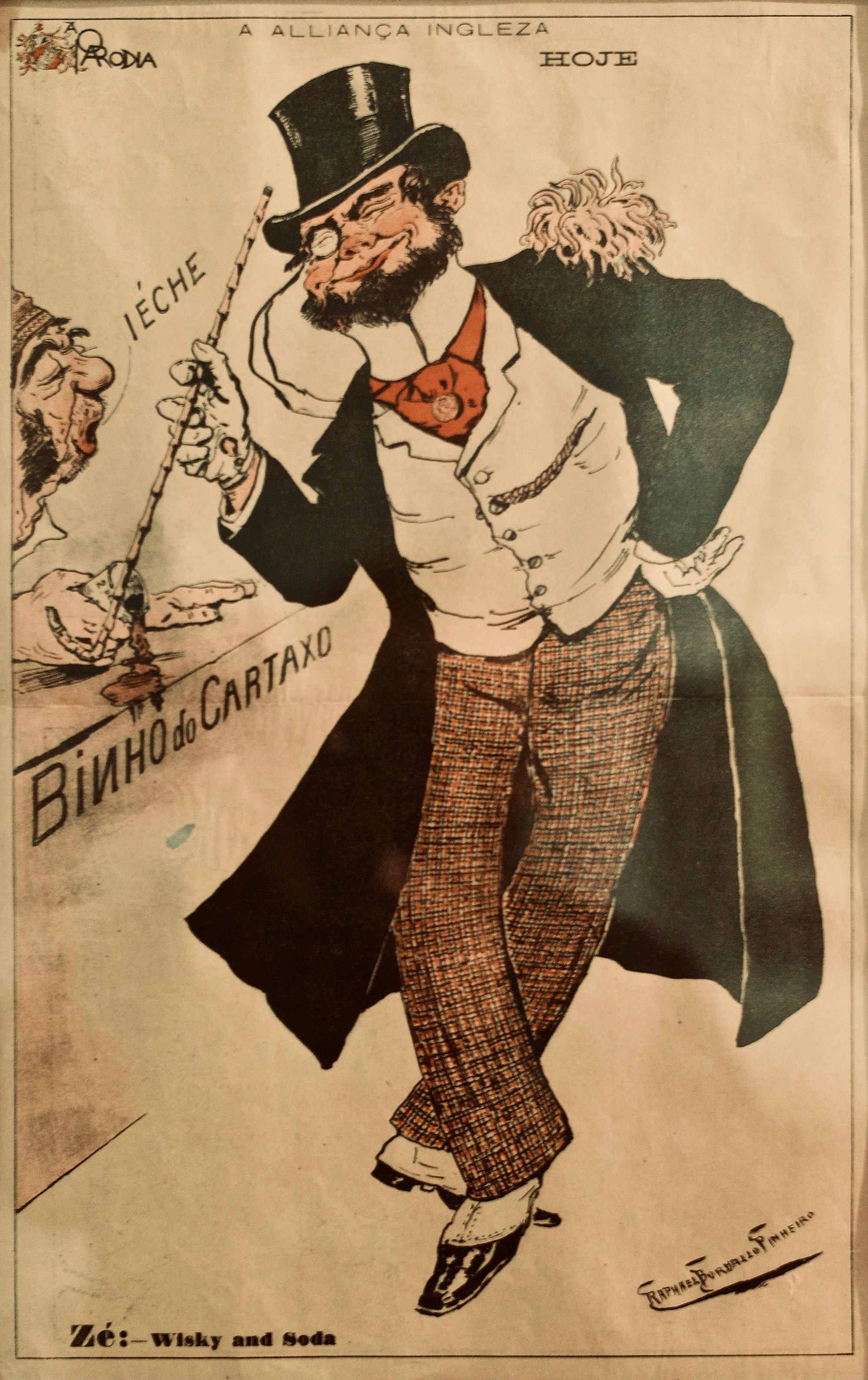
Rafael Bordalo Pinheiro’s The English Alliance places Zé Povinho in a tavern, using drink and popular culture to comment on Portugal’s political relationship with Britain.
The Caricaturist Changes Medium
Rafael Bordalo Pinheiro was not trained through a conventional pottery apprenticeship. By the time he experimented with ceramics at the Sacavém factory in 1883, he had already built a major career as an illustrator, journalist, and political caricaturist. His satirical publications began in the 1870s, and in 1875 he created Zé Povinho, a contradictory personification of the Portuguese public who remains one of the country’s best-known popular characters.
The Caldas da Rainha Faience Factory was formally established in 1884. Rafael directed its artistic and technical work, while his brother Feliciano handled management. Its ambitions were broader than decorative ceramics for prosperous collectors. The founding documents envisioned architectural materials, ornamental pieces, fine printed faience, everyday objects, and ordinary tableware intended for less wealthy households. Tableware production became a defined part of the business in 1888.
Bordalo entered ceramics with a fully formed way of looking at the world. A successful caricature depends on selection. It does not enlarge every feature equally. It isolates the nose, posture, gesture, costume, appetite, or social habit that exposes the subject most efficiently.
His ceramics follow the same procedure. A cabbage is reduced to stalk, rib, wrinkle, and overlapping leaf. A fish becomes scale, fin, open mouth, and accusatory eye. A lobster is all armor, claw, leg, and latent aggression. A frog is compressed into crouched limbs, wet surface, and an expression that suggests it has been listening to the conversation.
The switch from ink to clay changed the physical problem but not the critical temperament. Bordalo continued to identify characters, tell stories, and find comedy in the ridiculous. The difference was that the cartoons could now serve soup, pour water, hold toothpicks, or sit inconveniently on a mantel.
Why Cabbages, Tomatoes, Fish, and Frogs?
The documented vocabulary of his ceramics includes cabbage, cucumber, pepper, turnip, tomato, garlic, potato, chestnut, cherry, peach, grape, and loquat. Animals range from cats, dogs, chickens, ducks, monkeys, and doves to frogs, beetles, bees, lizards, and snakes. Fish and shellfish appear alive, dead, cooked, dried, netted, or arranged as elaborate food displays: lobsters, sardines, eels, cod, oysters, mussels, sea bass, bream, and game.
This was not nature as an abstract source of pleasant organic shapes. It was the material inventory of Portugal.The objects refer to market gardens and coastal fishing, rural kitchens and urban restaurants, domestic pets and agricultural labor. Bordalo also imitated fishing nets, baskets, wicker, cloth, grass, gloves, slippers, and hats in glazed clay, testing how convincingly one material could impersonate another.
The resulting pieces are often described as charming or playful, but those words can obscure how odd they actually are. A basket containing ceramic dried cod and onions is not simply decorative. It freezes an ordinary group of ingredients into an elaborate still life. A platter occupied by a lobster makes the food permanent while making the vessel seem temporarily unusable. A box covered with fruit and topped by a monkey turns the lid handle into a small domestic narrative.
Bordalo’s fish and shellfish pieces are particularly theatrical. Sardines, eels, crabs, lobsters, and bivalves spill across plates, baskets, nets, and pots with the compositional ambition of still-life painting and the blunt physicality of a market stall.
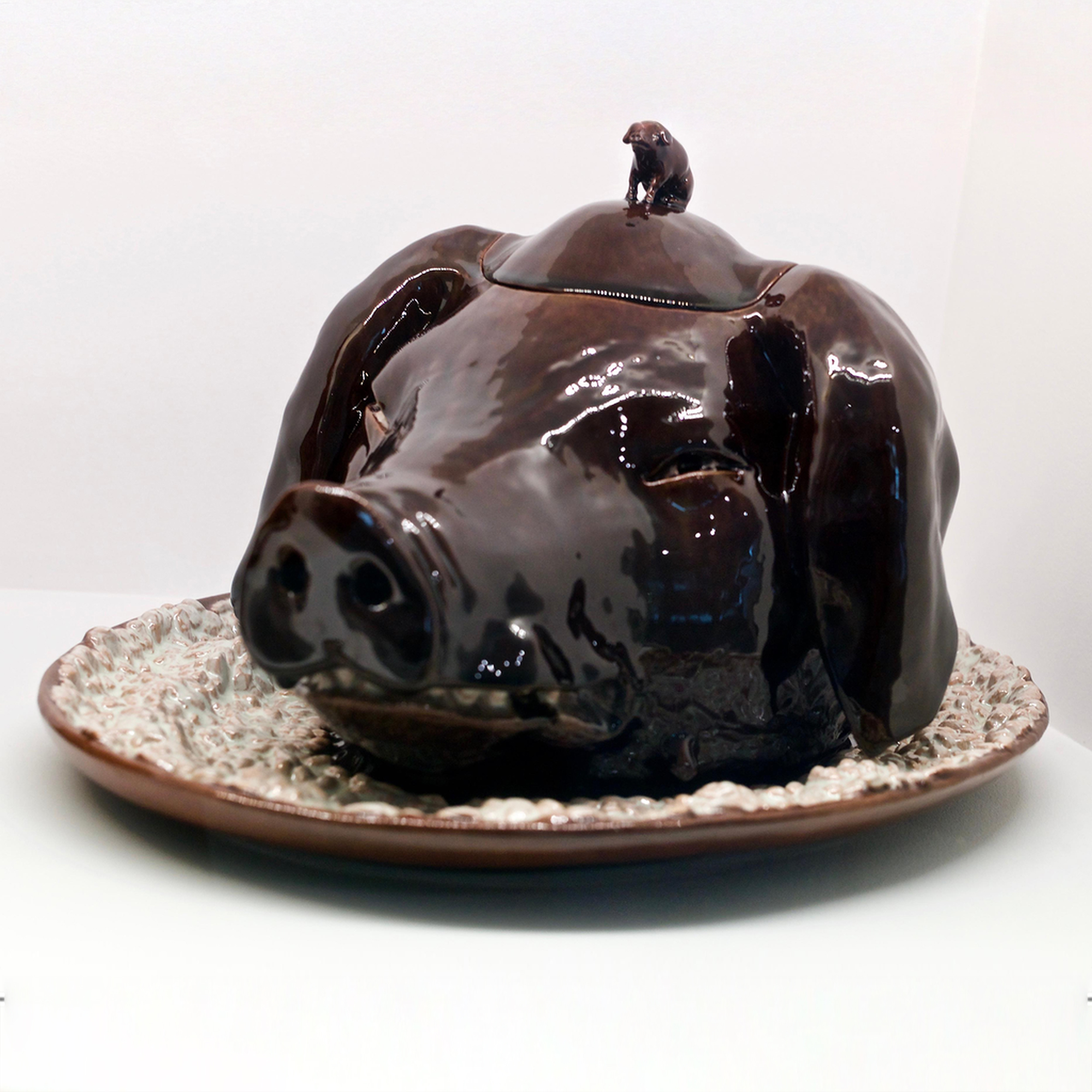
Rafael Bordalo Pinheiro, Cabeça de Porco tureen with serving dish. The animal’s head provides both the image and the structure of the covered vessel.
Realism with the Volume Turned Up
Look closely at a Bordallo Pinheiro cabbage plate and the design appears to promise documentary accuracy. Every branching vein has been modeled. The central rib is thick and pale. The surface puckers between the leaf’s structural lines. The depth of the relief is greater than a dinner plate requires. The glaze pools in the recesses, darkening the green and making every wrinkle more pronounced. The outer edge rises and falls with theatrical regularity. It is convincing as a cabbage leaf without being mistaken for one.
The same method applies to a tomato. Its rounded irregularities are softened into an instantly readable silhouette, while the green calyx is isolated against a field of saturated red. A fish receives more orderly scales, a clearer eye, and a more purposeful mouth than nature generally bothers to provide.
Bordalo’s realism is edited reality. That is where naturalism and caricature meet. Both are based on recognition, but caricature turns recognition into emphasis. The object tells the truth loudly.
Drawings played an important part in the development of the ceramics, as did models taken from real plants and animals. The factory established these practices as part of its prototyping system, with specialist workers developing molds and passing the required knowledge to apprentices.
This makes the work more systematic than its apparent exuberance suggests. The forms may look spontaneous, but they depended on drawing, modeling, mold making, assembly, glazing, firing, and painting. Their humor had to survive all of those stages.
The current company continues to describe its production as a combination of long-established techniques and skilled handwork, drawing from original models by Rafael and his son Manuel Gustavo, later developments based on those models, and entirely new collections.
The method was never simply “copy a vegetable.” It was to observe, select, exaggerate, translate, reproduce, and finish—while ensuring that the final object still had somewhere to put the salad.
When the Vessel Looks Like Dinner
Food-shaped ceramics create a useful confusion between container and contents. A tomato tureen may hold soup, but its swollen red body announces a very specific ingredient before the lid is lifted. The stem becomes a handle. The fruit’s irregular shape gives the vessel its volume. A practical object behaves like a still life with storage space.
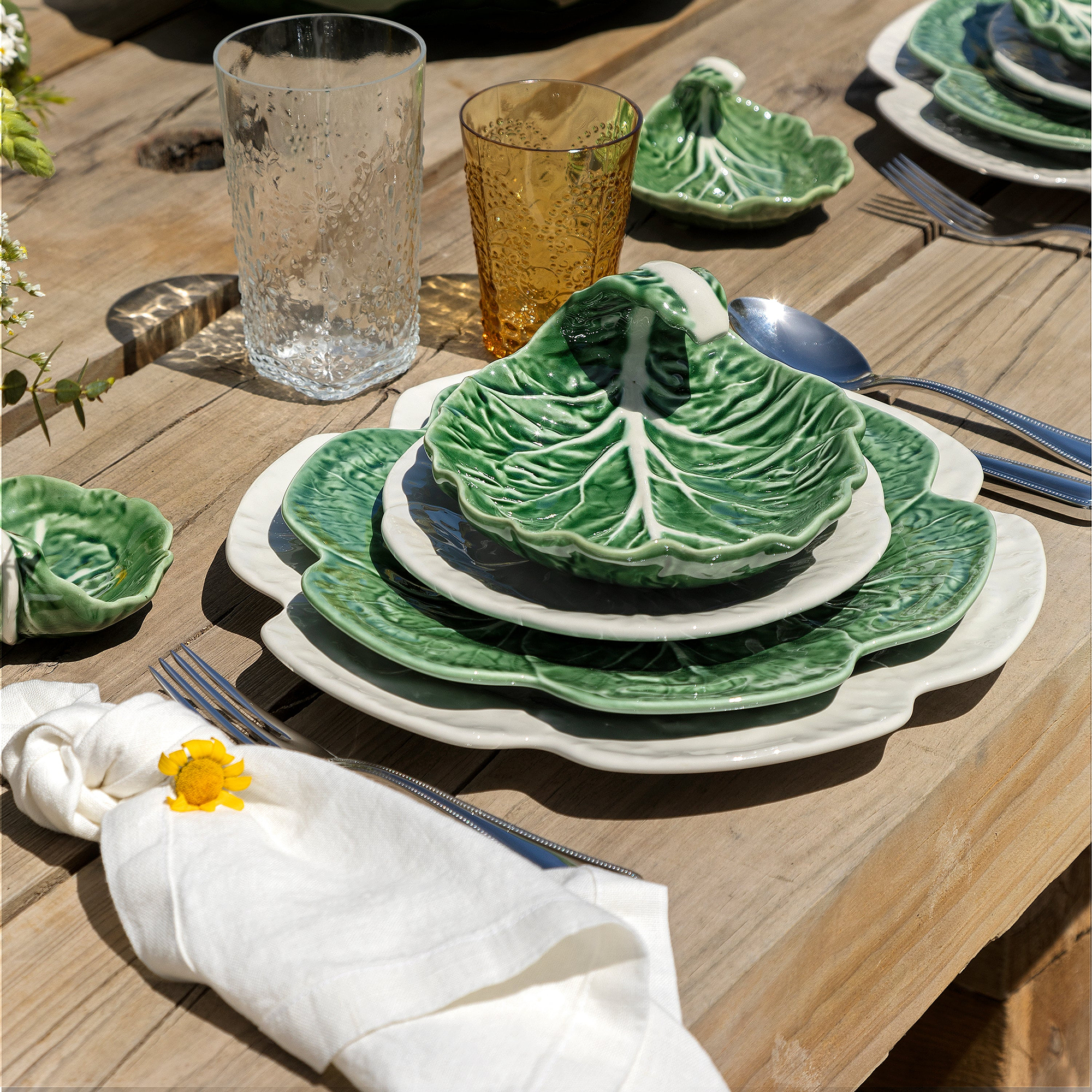
The cabbage performs the same trick more subtly. A ceramic cabbage serving dish can hold the vegetable it imitates, another food entirely, or nothing at all. In each case, the relationship between form and use changes.
A fish ceramic pitcher goes further. The animal’s body becomes the reservoir, its tail or fins provide structure, and its mouth becomes the point of delivery. Pouring water turns into a brief zoological event. The pitcher has not merely been decorated with a fish. It has agreed to become one.
Bordalo’s 1889 Round Plate with Lobster, now in the Metropolitan Museum of Art, pushes the idea toward functional absurdity. A fully modeled lobster occupies the plate’s center against a radiating blue ground. The crustacean is food, sculpture, obstruction, and composition at the same time. The Met identifies it as glazed earthenware and places it within Bordalo’s Palissy-inspired production.
The effect can feel unexpectedly close to later Surrealist strategies: an ordinary domestic object is made strange by taking its representational logic too seriously.
Yet Bordalo generally stopped before function disappeared completely. The museum’s analysis notes that, even beneath dense naturalistic ornament, the underlying type—plate, jug, pot, pitcher, or tureen—remained visually distinct. That discipline separates the strongest Bordallo Pinheiro ceramics from novelty objects.
The Table as Social Theater
Food already carried political weight in Bordalo’s graphic work. His drawings documented markets, kitchens, restaurants, cafés, banquet halls, and domestic dining rooms. They also turned food into political language. Government maneuvers became stews. Electoral arrangements were presented as cooking. Politicians appeared as chefs, maids, servants, and wet nurses. Menus provided a framework for mocking state budgets and the elaborate French terminology of polite dining.
Bordalo understood the table as a place where class performs itself. A formal meal makes social position visible through ingredients, service, manners, seating, tableware, and the amount of food that can be wasted. His work mocked lavish excess and refined etiquette while also recording poverty and hunger. He designed personalized menus, decorated banquet interiors, and arranged his own ceramics among flowers and plants to produce deliberately surprising displays.
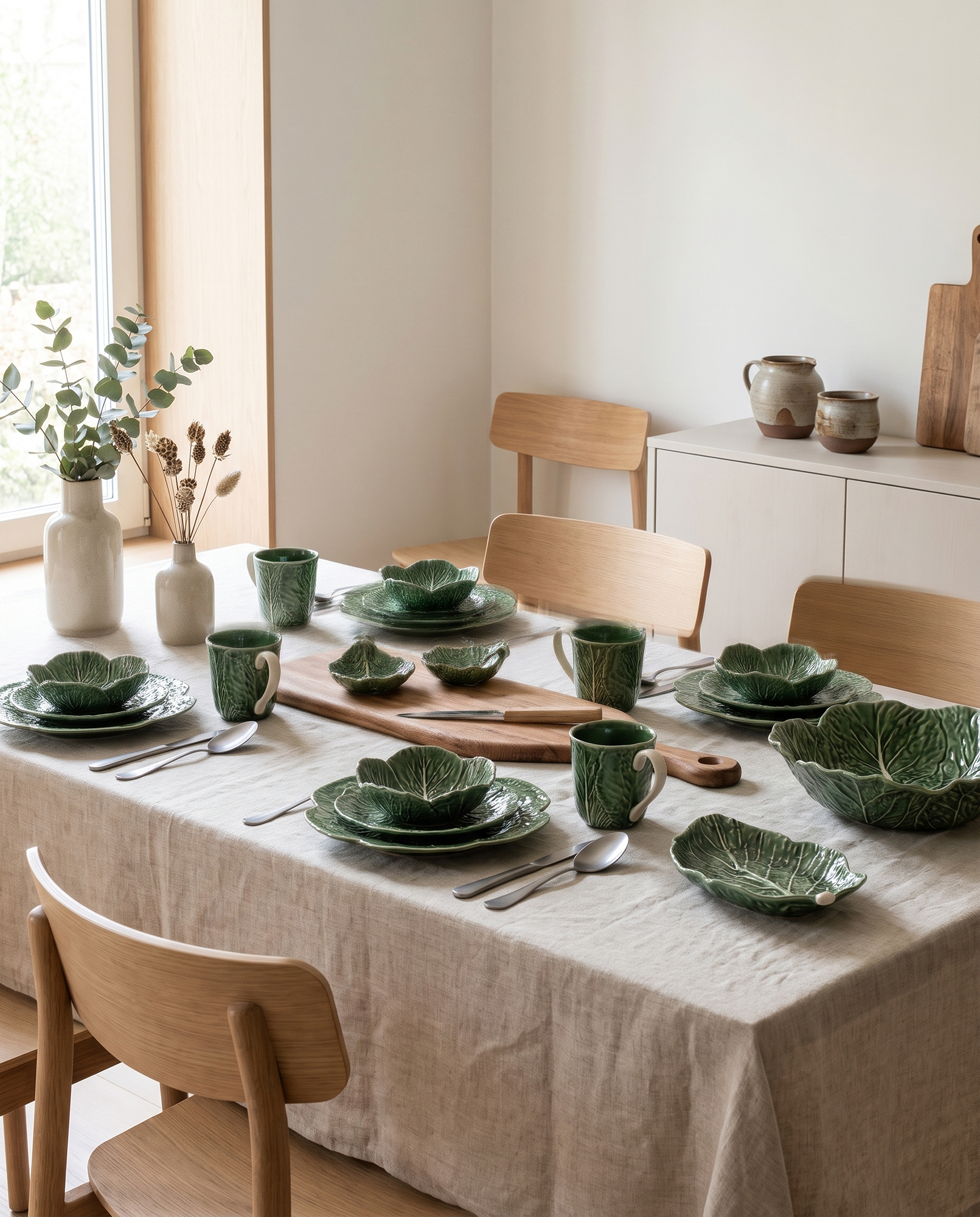
Seen against that background, the cabbage is not an isolated botanical experiment. It is cheap food transformed into expensive-looking display. Rural produce becomes bourgeois equipment. The object crosses categories that were meant to remain separate: kitchen garden and dining room, ordinary diet and decorative art, popular culture and cultivated taste.
There is another productive contradiction here. Although the cabbage could lampoon bourgeois ceremony, the factory itself planned to manufacture ordinary tableware for households with limited means. Bordalo’s project was not simply an outsider’s attack on luxury. It was an attempt to bring artistic invention into industrial and everyday production.
His tableware could therefore satirize social distinction while participating in a broader effort to redesign ordinary Portuguese objects. The ceramic cabbage is both intruder and citizen.
Majolica, Faience, or Earthenware?
Bordallo Pinheiro ceramics are often described in the antiques market as Portuguese majolica. The term is useful for search and broadly understandable, but it requires some untangling.
Maiolica originally referred to Italian tin-glazed earthenware. During the nineteenth century, the anglicized spelling majolica also became attached to brightly colored, lead-glazed naturalistic pottery that had previously been marketed as Palissy ware. As the V&A explains, the terminology changed over time and came to cover more than one ceramic tradition.
Portuguese museum texts commonly describe Bordalo’s work as faience, while the Metropolitan Museum of Art identifies the 1889 lobster plate as glazed earthenware. Current Bordallo Pinheiro product pages generally list the tableware body as earthenware, although the wider company catalog and collaborations can also include other ceramic materials.
For a general audience, “Portuguese majolica” remains a recognizable description of the colorful naturalistic category. “Faience,” “glazed earthenware,” and “earthenware” are usually more precise when discussing a documented museum object or a current product specification.
The words overlap historically, but they are not decorative synonyms to scatter around until a paragraph sounds expensive.
Why Bordallo Pinheiro Works Now
Cabbageware is enjoying another conspicuous return. During 2025 and 2026, major lifestyle and design publications presented cabbage-shaped tableware as a decorating trend, a collectible category, and eventually an entire visual phenomenon called “cabbagecore.” Bordallo Pinheiro appeared repeatedly as the historical point of reference.
The ceramics were doing perfectly well before the suffix arrived. It is tempting to explain their renewed appeal as a reaction against years of neutral interiors, pale stoneware, and table settings designed to offend nobody. Bordallo certainly provides color, relief, figuration, and the occasional open-mouthed fish. But the work’s relevance runs deeper than a pendulum swing from minimalism to maximalism.
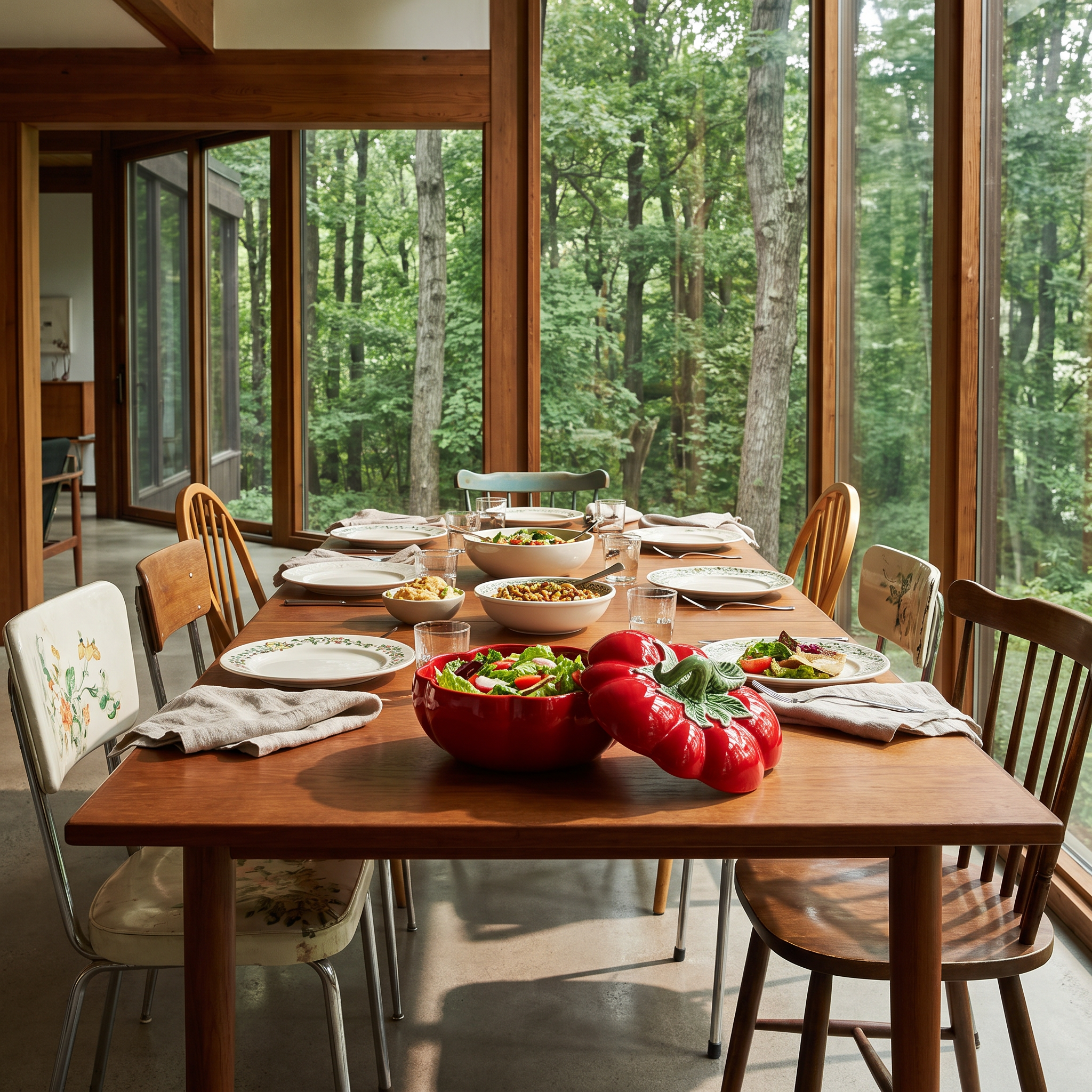
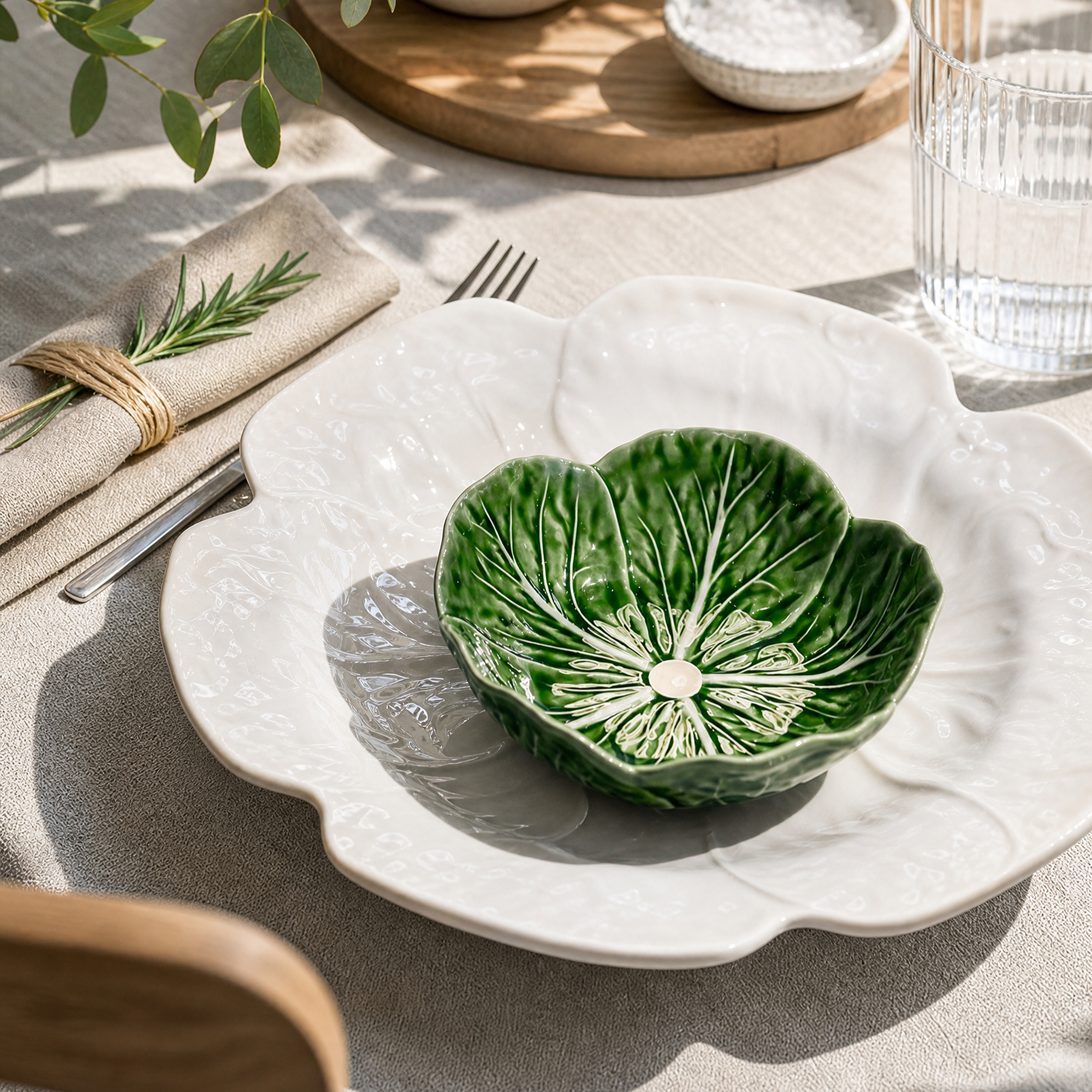
The objects are immediately legible. A visitor does not need a wall label to identify a tomato, cabbage, banana, or duck. The surprise comes from scale, material, and function. The familiar subject has been put to unfamiliar work. They are also self-contained. A single cabbage bowl can sit on a plain wood table without requiring an entire room to follow its instructions. A tomato tureen can be used among white plates. A fish pitcher can operate as the one unruly guest in an otherwise orderly setting.
This makes the collection easy to integrate into contemporary interiors. The pieces carry their own color, texture, image, and narrative. They do not depend on a matching suite or a heavily decorated room to make sense.
They also improve through use. Food changes the visual reading of the vessel. Salad extends the cabbage. Tomatoes inside a tomato bowl turn imitation into repetition. A ceramic fish pitcher becomes stranger when it actually pours.
The strongest pieces remain suspended between good design and questionable taste. Remove too much modeling and the joke disappears. Add too much and the object becomes merely grotesque. Bordalo’s achievement was not avoiding that boundary but working directly on it.
The ceramics can appear comic, theatrical, excessive, technically accomplished, and useful in the same glance. That is a more durable proposition than being fashionable.
The Joke Survives
Rafael Bordalo Pinheiro entered ceramics with the instincts of a caricaturist.
He observed closely, selected ruthlessly, and exaggerated the detail that revealed the subject. In clay, this method produced cabbages with architectural veins, fish with undeniable opinions, tomatoes large enough to store dinner, and lobsters unwilling to remain politely at the edge of the plate. The naturalism made the objects recognizable. The caricature made them active.
More than a century later, the Bordallo Pinheiro collection is most convincing when it preserves that tension. Historic molds matter, but repetition alone is not enough. New collections matter when they extend the design logic rather than merely borrowing the surface decoration.


